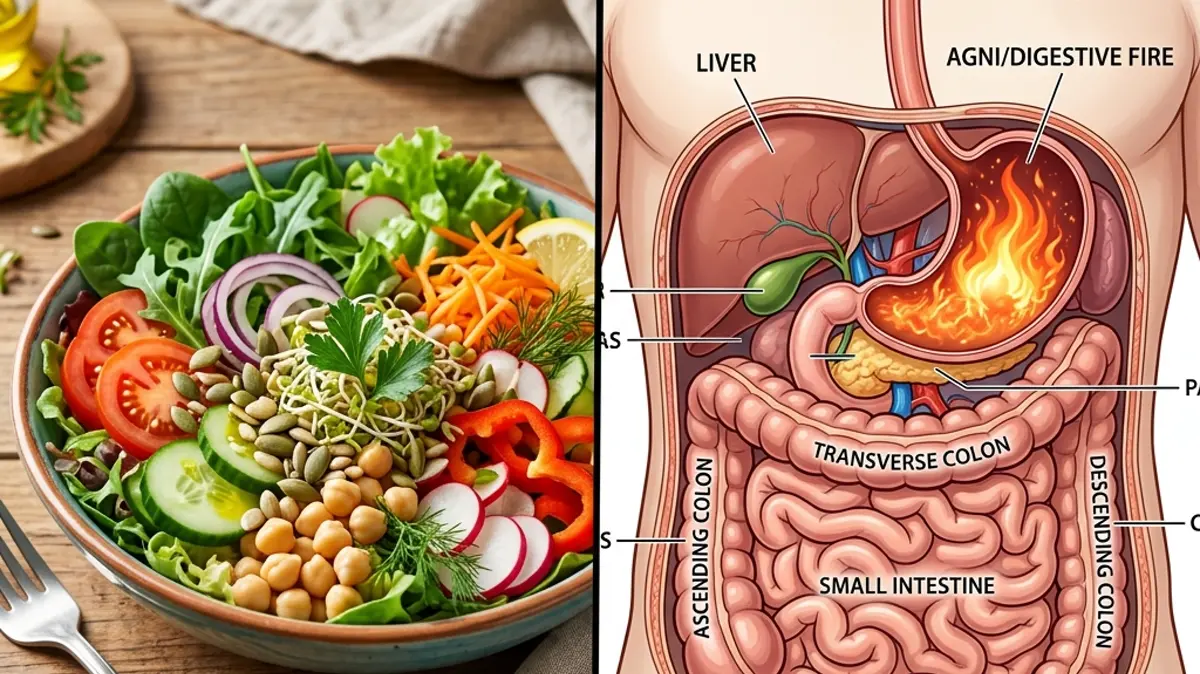
"Pouring cold water on a burning log snuffs out the fire, leaving only damp smoke. In the same way, filling a delicate stomach with cold, raw leaves snuffs out the digestive fire, leaving behind bloating and gas."
The raw food diet has taken the global wellness world by storm, praised as the ultimate way to consume living enzymes and maximize nutrient intake. Social media feeds are filled with giant green salads, raw vegetable juices, and uncooked grain bowls. However, from a clinical Ayurvedic perspective, a long-term, 100% raw food diet represents a severe threat to digestive fire (Agni) and a primary catalyst for Vata dosha aggravation.
Many health enthusiasts transition to raw foods to cure fatigue or digestive issues, only to experience chronic bloating, gas, and dry skin after a few months. Modern nutrition often focuses solely on the raw vitamin content of food, ignoring the energy needed to digest it. Re-establishing optimal digestive health requires understanding how cooking acts as a form of external pre-digestion.
Restoring digestive strength demands an evaluation of food qualities. By studying how raw structures impact the gut lining and using traditional warm nutrition, we can protect our internal balance. This article evaluates the raw food trend, the pathology of cold foods, and the Ayurvedic principles of warm, cooked nourishment.
The Biomechanics of Digestion: Why Raw Food Overloads Agni
In traditional Ayurveda, health begins with Agni, the digestive fire. Agni is responsible for breaking down food, absorbing nutrients, and maintaining body temperature. For nutrients to reach the tissues (Dhatus), food must be transformed into a warm, soft, and liquid state that matches the body's internal environment.
Raw vegetables possess the qualities of Ruksha (dry), Sheeta (cold), Laghu (light), and Khara (rough). These are the exact qualities of Vata dosha. When a person consumes raw foods, the body must produce extra heat and digestive enzymes to warm up the cold mass and break down the tough, fibrous cell walls of the raw plants.
This heavy energy requirement places a massive load on Agni. Over time, the constant demand for heat exhausts the digestive fire, leading to a state of Mandagni, or sluggish digestion. The undigested raw food begins to ferment in the warm, damp environment of the colon, producing gas and a toxic residue called Ama.
Clinical indications of raw food impact on Agni and Vata dosha:
- 1Agni Energy StrainDigesting raw cellulose requires up to 50% more metabolic heat (Prana) than cooked vegetables.
- 2Vata Gas IncreaseA long-term raw diet increases bowel gas production (flatulence) by over 60% in Vata constitutions.
- 3Nutrient Assimilation DropA weak Agni reduces the absorption of fat-soluble vitamins (A, D, E, K) by up to 40%.
- 4Optimal Cooking BenefitSteaming and cooking with Ghee increases nutrient bioavailability by breaking down fiber walls.
The Clinical Opinion: Pre-Digestion via Cooking vs. Raw Enzyme Preservation
"Following a 100% raw food diet is a direct path to chronic Vata nervous disorders and digestive weakness. In my clinical opinion, the theory that raw enzymes are essential for health ignores the fact that human stomach acid neutralizes most dietary enzymes anyway. By cooking vegetables with warming spices and Ghee, we pre-digest the fiber, kindle the internal Agni, and ensure nutrients are actually absorbed by the cells."
Proponents of raw food argue that cooking destroys natural plant enzymes, reducing the food's vitality. While cooking does alter some enzymes, it also breaks down complex plant fibers that the human digestive system is not equipped to process in large quantities. Ayurveda views cooking as an essential step that prepares food for the internal fire.
Cooking with warming spices like cumin, ginger, and turmeric infuses the food with fire energy (Tejas), making it lighter and easier to digest. Adding a small amount of Ghee provides lubrication (Snigdha), which neutralizes the dryness of plant fiber and protects the gut lining from Vata's rough quality.
The Ayurvedic Guide to Balanced Vegetable Consumption
Maintaining digestive health does not require avoiding all fresh foods, but rather matching food preparation to your constitution and the season.
1. Kind of Cooking (Pachana)
For most individuals, vegetables should be steamed, roasted, or sautéed rather than eaten raw. Cooking softens the fiber and warms the food, aligning it with the stomach's natural temperature. This preserves Agni and allows for smooth digestion without bloating.
Always incorporate warming spices into your cooking. Sautéing vegetables in a teaspoon of Ghee with cumin, mustard seeds, and ginger helps stimulate digestive juices and balances Vata. This simple step turns hard-to-digest greens into nourishing food.
2. Seasonal Adaptation (Ritucharya)
The amount of raw food you can tolerate depends heavily on the season. During the hot summer months (Pitta season), the external heat supports digestion, and the body requires cooling foods. A small salad can be enjoyed during lunch when Agni is naturally at its peak.
In contrast, during the cold autumn and winter months (Vata season), raw foods should be avoided. The body requires warm, moist, and grounding meals like soups and grains to balance the external cold. Eating raw salads in winter is a prime trigger for joint pain and dry skin.
3. Constitutional Matching (Prakriti)
Pitta constitutions, who have a naturally strong, hot Agni, can tolerate raw foods better than other types. They benefit from the cooling qualities of fresh cucumber, coriander, and leafy greens. However, even Pitta types should avoid raw diets during cold seasons.
Vata constitutions, who have a delicate, irregular Agni, should avoid raw foods almost completely. They require warm, well-cooked, and oily meals to keep their nervous system grounded. Kapha types should focus on warm, dry, and heavily spiced cooked vegetables, avoiding cold raw salads that create congestion.
Protecting the Digestive Fire
The raw food trend is a modern example of prioritizing theoretical nutrient values over actual digestive capability. In Ayurveda, you are not what you eat, but what you digest. Protecting our Agni through warm, cooked, and spiced nourishment is the true foundation of cellular health and mental peace.
To learn more about digestive health and nutrition, read our detailed guides on the concept of Agni, the six tastes of Ayurveda, and understanding toxic Ama. You can also review our trend audits of the cold plunge ice bath trend, the adaptogenic mushroom coffee trend, and the benefits of Ayurvedic Ghee.
Featured image attribution: Left panel displays a visual representation of a colorful raw salad bowl with fresh vegetables and seeds. Right panel shows a detailed clinical 3D anatomical illustration highlighting the stomach's digestive fire (Agni) and the structure of the small and large intestines in the human body. Modified by cropping and compositing.
Dr. Dhanushika Dilshani
Expert Ayurvedic Wellness Doctor. Specialized in modern holistic wellness, optimizing dermal resilience, cosmetic radiance, and systematic diagnosis driven by traditional and evidence-based medical logic.
Medical Disclaimer
The information provided by AyurPhysio is for general educational and informational purposes only. It is not intended as a substitute for professional medical advice, diagnosis, or treatment. Always seek the advice of your physician or other qualified health providers with any questions you may have regarding a medical condition. Never disregard professional medical advice or delay in seeking it because of something you have read on this website.
Trending Guides
Luka Modrić's Daily Routine: Low-Impact Resistance Training and Midfield Longevity
4 min readHarry Kane's Daily Routine: Hamstring Preservation and Anti-Inflammatory Nutrition
4 min readKarim Benzema's Daily Routine: Cupping Therapy (Hijama) and HIIT Conditioning
4 min readNeymar Jr.'s Daily Routine: Joint Stabilization and Hyperbaric Oxygen Therapy
4 min readMohamed Salah's Daily Routine: Early Morning Conditioning and Hyperbaric Recovery
4 min readWeekly Wellness
Don't miss the next guide
Get holistic health tips and new guides delivered to your inbox.
Related Healing Guides
View All Guides →
Luka Modrić's Daily Routine: Low-Impact Resistance Training and Midfield Longevity

Harry Kane's Daily Routine: Hamstring Preservation and Anti-Inflammatory Nutrition