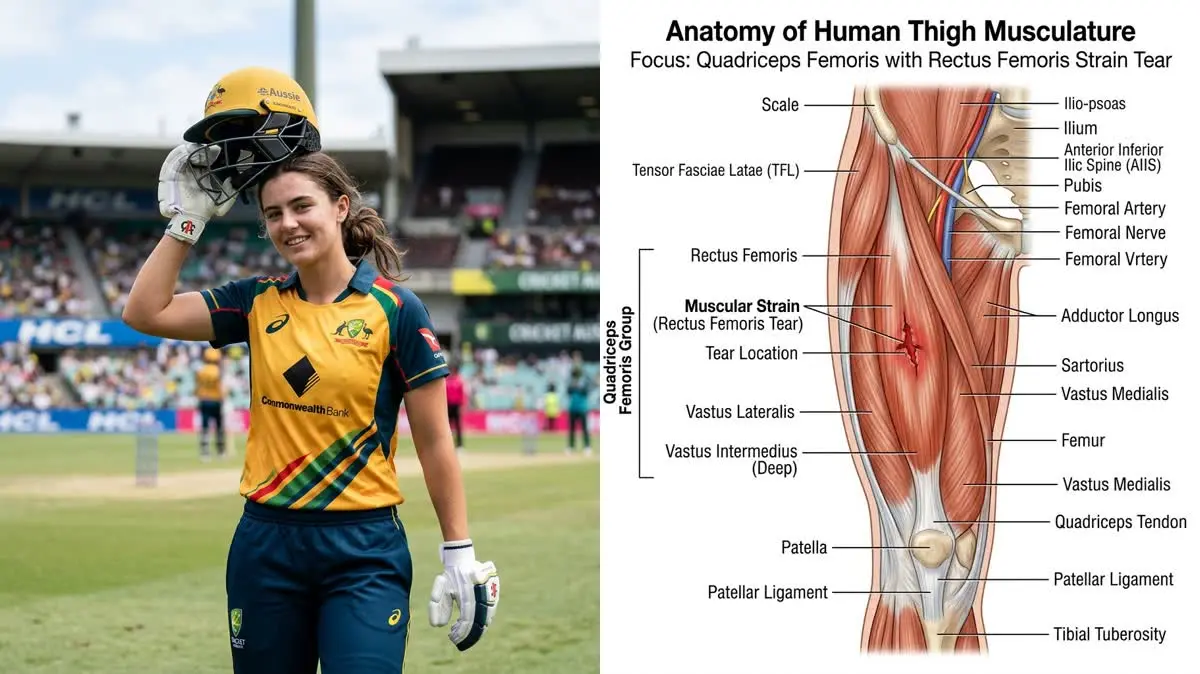
"A quadriceps strain is like a frayed high-tension steel cable holding a suspension bridge. Under steady weight, the bridge stays stable, but if you slam on the brakes or hit a bump, the frayed cable will unravel under the sudden load."
The Australian women's cricket team suffered a major blow when star batter Phoebe Litchfield was diagnosed with a severe quadriceps strain during training. This injury has ruled her out of the upcoming opening matches of the season, leaving a critical gap in the top batting order. For an elite cricketer whose game relies on explosive sprinting between the wickets and high-impact fielding, quadriceps strength is a vital necessity for success.
Traditional treatment for a thigh strain often involves passive rest and ice, which can lead to muscle tightness and loss of power. However, for a professional athlete, prolonged rest is rarely the best path to full performance recovery. Modern sports physical therapy focuses on active loading and precise eccentric exercises to promote healthy tissue repair.
Restoring a strained muscle to handle high-velocity deceleration requires a deep understanding of muscle architecture and lower extremity biomechanics. By applying targeted forces through the leg and implementing a structured phoebe litchfield injury rehabilitation protocol, we can rebuild a resilient muscle. This article explores the forces that cause quadriceps trauma and details the clinical stages of thigh reconditioning.
The Biomechanics of Cricket Deceleration and Quadriceps Load
The quadriceps femoris is a group of four large muscles on the front of the thigh that work together to extend the knee and flex the hip. Among these, the rectus femoris is the most vulnerable to injury because it crosses both the hip and knee joints. During high-speed running, this muscle experiences extreme stretch and contraction force as the athlete prepares to stop or turn.
In cricket, players must decelerate rapidly when chasing the ball in the outfield or when turning at the crease during runs. This rapid stopping requires the quadriceps to work eccentrically, which means the muscle is actively contracting while it is being lengthened. The force can exceed the muscle fibers' elastic limit, leading to micro-tearing or a complete muscle strain.
Clinical data indicates that quadriceps strains make up about 10% of all muscle injuries in field sports. Furthermore, up to 70% of these strains involve the rectus femoris muscle at the myotendinous junction. Rebuilding this tissue requires a progressive loading program that increases the muscle's capacity to absorb deceleration forces.
Clinical metrics tracking quadriceps muscle healing and performance outcomes:
- 1Muscle Strain PrevalenceQuadriceps strains account for approximately 10% of all lower extremity muscle injuries in athletes.
- 2Grip & Strength DeficitFailing to restore full quadriceps strength symmetry increases re-injury risk by 3 times.
- 3Tissue Healing WindowSkeletal muscle healing and remodeling of a Grade II strain requires 4 to 6 weeks.
- 4Deceleration Force PeakDeceleration movements generate eccentric quadriceps loads up to 8 times body weight.
The Clinical Opinion: Active Loading vs. Passive Rest
"Following a quadriceps muscle strain, the primary goal is to promote scar tissue remodeling along the line of muscle fibers. In my clinical opinion, passive rest and prolonged icing delay tissue healing and lead to a weak, stiff muscle scar. We must introduce controlled isometric contractions within the first 48 hours to stimulate healthy blood flow and preserve muscle activation."
Early isometric activation applies light tension to the healing muscle fibers, which prevents the formation of a stiff, chaotic scar. This active approach preserves the sliding mechanism of the thigh muscles and protects the patient from chronic tightness. By maintaining muscle contraction, we also protect the knee joint from patellofemoral tracking issues caused by weakness.
Furthermore, early movement helps maintain the strength of the quadriceps, specifically the vastus medialis, which stabilizes the patella. Protecting this muscle from wasting is critical because it handles the forces transmitted during squatting and jumping. A progressive loading program is the key to restoring this muscular support and protecting the joint.
Multi-Stage Quadriceps Rehabilitation Protocol
Rebuilding the quadriceps muscle requires a structured program that respects muscle healing times while restoring explosive power.
Phase 1: Protection and Gentle Isometric Loading (Weeks 1-2)
In the acute phase, the primary goals are to protect the healing muscle, reduce localized swelling, and maintain joint mobility. We utilize a compression sleeve to support the thigh and minimize internal bleeding at the injury site. Active knee movement is performed in a pain-free range, limiting flexion to 90 degrees to avoid overstretching the rectus femoris.
We begin gentle isometric quadriceps contractions, where the patient presses the back of the knee down against a towel roll. These holds are performed for 10 seconds, 10 times, to maintain muscle activation without moving the joint. Swelling is managed through compression, elevation, and gentle active ankle pumps to promote blood flow.
Phase 2: Progressive Eccentric Strength and Weight-Bearing (Weeks 3-6)
As the muscle heals and pain resolves, we transition the athlete toward weight-bearing exercises and eccentric loading. We introduce bodyweight squats, stepping up on a low box, and split squats, keeping the knee aligned over the second toe. We gradually add eccentric leg extensions, where the patient lowers the leg slowly over 4 seconds against light resistance.
This eccentric loading is crucial because it strengthens the muscle fibers at longer lengths, preparing them for deceleration forces. The athlete performs 3 sets of 10 repetitions, three times per week, ensuring all movements are pain-free. We also incorporate hip abduction exercises to build stability and support lower limb alignment.
Phase 3: Plyometric Deceleration and Sports-Specific Conditioning (Weeks 6-8)
This final phase focuses on restoring explosive sprint power, jumping stability, and cricket-specific acceleration and deceleration mechanics. We begin double-leg landing drills off a low box, focusing on absorbing the impact forces softly. We progress to single-leg hops, lateral shuffles, and sudden deceleration stops from a light run.
We introduce linear sprinting, starting at 50% speed and gradually increasing to maximum velocity over two weeks. We monitor the thigh muscles for any post-exercise tightness or soreness, adjusting the volume as needed. The athlete performs these plyometric and running sessions twice weekly, ensuring adequate recovery between workouts.
Kinetic Chain Integration
A quadriceps strain affects the mechanics of the entire lower extremity, leading to hip compensations and altered stride length. Weakness in the thigh muscles forces the glutes and calf muscles to work harder during walking and running. To prevent secondary injuries, the rehabilitation program must include gluteus medius strengthening and hamstring conditioning.
For more lower extremity recovery guidelines, read our detailed guide on patellofemoral pain syndrome hip abductor fixes and view our breakdown of groin strain adductor strengthening. To understand tendon loading, check our analysis of patellar tendinopathy decline squats and IT band syndrome rehabilitation. To learn about sprint biomechanics, view our analysis of Elly De La Cruz hamstring strain deceleration recovery.
Featured image attribution: Left panel photo of Phoebe Litchfield adapted from Wikimedia Commons page (File:Phoebe Litchfield 2024.jpg). Right panel displays a clinical anatomical diagram of human quadriceps muscle strain. Modified by cropping and compositing.
Dr. Dhanushika Dilshani
Expert Ayurvedic Wellness Doctor. Specialized in modern holistic wellness, optimizing dermal resilience, cosmetic radiance, and systematic diagnosis driven by traditional and evidence-based medical logic.
Medical Disclaimer
The information provided by AyurPhysio is for general educational and informational purposes only. It is not intended as a substitute for professional medical advice, diagnosis, or treatment. Always seek the advice of your physician or other qualified health providers with any questions you may have regarding a medical condition. Never disregard professional medical advice or delay in seeking it because of something you have read on this website.
Trending Guides
Luka Modrić's Daily Routine: Low-Impact Resistance Training and Midfield Longevity
4 min readHarry Kane's Daily Routine: Hamstring Preservation and Anti-Inflammatory Nutrition
4 min readKarim Benzema's Daily Routine: Cupping Therapy (Hijama) and HIIT Conditioning
4 min readNeymar Jr.'s Daily Routine: Joint Stabilization and Hyperbaric Oxygen Therapy
4 min readMohamed Salah's Daily Routine: Early Morning Conditioning and Hyperbaric Recovery
4 min readWeekly Wellness
Don't miss the next guide
Get holistic health tips and new guides delivered to your inbox.
Related Healing Guides
View All Guides →
Luka Modrić's Daily Routine: Low-Impact Resistance Training and Midfield Longevity
Harry Kane's Daily Routine: Hamstring Preservation and Anti-Inflammatory Nutrition