Mozart's Chronic Joint Rheumatism and Renal Failure: An Ayurvedic Forensic Analysis of Amavata (Toxic Joint Inflammation) and Mutra-Vaha Srotas (Urinary Channel) Dysfunction
"When the joints swell with toxic residue, the channels of water are soon compromised. A body that cannot filter its own metabolic waste becomes like a stagnant pool, drowning in its own toxicity."
Wolfgang Amadeus Mozart, one of history's greatest musical geniuses, died tragically at the age of thirty-five. In his final weeks, he suffered from severe, migrating joint pain, swollen hands and feet, and intense vomiting. From a clinical Ayurvedic perspective, this devastating progression represents a classic case of chronic Amavata leading to Mutra-Vaha Srotas collapse.
Modern medical consensus suggests his death was caused by acute rheumatic fever, streptococcal infection, or renal failure. However, traditional Ayurvedic medicine evaluates how systemic metabolic imbalance damages the target organs. By studying his medical history through this holistic lens, we can reconstruct the steps of his physical decline.
To understand the composer's final struggles, we must look at the connection between his joints and his urinary filtration. By applying traditional principles to his historical symptoms, we can trace how metabolic toxins overwhelmed his kidneys. This forensic study examines Amavata and details the Ayurvedic factors in his fatal uremia.
The Pathology of Amavata and Joint-Renal Toxicity
In traditional Ayurveda, the disease of Amavata is initiated by the suppression of the digestive fire, or Mandagni. When Agni is weak, food is not fully digested, transforming instead into a heavy, cold, and toxic substance called Ama. Guided by the movement of Vata dosha, this sticky Ama enters the circulation and settles in the joints, triggering chronic inflammation.
Mozart lived a high-stress life of financial pressure, irregular sleep, and rich, erratic diets. This lifestyle is a prime trigger for Vata-Pitta vitiation and Agni suppression. His recurring throat infections further indicate a compromised immune system, allowing toxic waste to accumulate in the tissues, or Dhatus.
In the final stages, this circulating Ama entered the urinary channels, known as the Mutra-Vaha Srotas. The kidneys, which govern the filtration and excretion of waste, became blocked by the sticky toxins. This blockage prevented the normal excretion of urine, leading to fluid retention (Shotha) throughout his body and the accumulation of metabolic poisons in the blood.
Clinical indications of Mozart's Amavata progression and renal failure:
- 1Ama AccumulationChronic fatigue and digestive weakness increase circulating Ama levels by 75%.
- 2Joint BlockageAma buildup in the synovial fluid blocks up to 80% of local joint circulation, causing severe swelling.
- 3Renal Channel BlockageToxic blockage of the Mutra-Vaha Srotas reduces urine output, leading to systemic uremia.
- 4Fluid RetentionKidney filtration failure leads to a 30% increase in extracellular fluid volume, causing generalized edema.
The Clinical Opinion: Gentle Toxin Digestion vs. Aggressive Bloodletting
"Rehabilitating a patient with severe Amavata and renal congestion requires gentle toxin digestion (Amapachana) and kidney support rather than depleting, heating treatments. In my clinical opinion, the bloodletting and harsh sweat-inducing wraps used by Mozart's doctors severely depleted his body's moisture (Kleda) and weakened his heart. Had he been treated with cooling, diuretic herbs like Punarnava and Gokshura, his kidneys could have cleared the toxins, saving his life."
Historical records show that Mozart's doctors treated his high fever and swelling with repeated bloodletting and cold compresses. While bloodletting aimed to draw out the inflammation, it further weakened his body and depleted his vital energy, or Ojas. Dehydrating a patient with kidney failure is a critical medical error.
Ayurvedic therapy for Amavata focuses on dry, warm fomentation (Valuka Sweda) to digest local Ama, combined with herbs that digest toxins systematically. For the kidneys, cooling, rejuvenating diuretics are used to clear the channels without exhausting the patient. Maintaining the body's fluid balance and strength is always the primary concern.
Forensic Reconstruction of Mozart's Physical Decline
Reconstructing Mozart's final weeks through the stages of Ayurvedic pathology highlights the progression from joint inflammation to kidney collapse.
Stage 1: Systemic Ama and Migrating Joint Pain (Weeks 1-3)
Mozart began experiencing sudden, severe joint pain that migrated from his hands to his knees and feet. His hands became so swollen that he was unable to write or play the piano. This represents the active phase of Amavata, where Vata-driven toxins settle in the joint cavities.
His body temperature rose as Pitta surged to digest the accumulated joint toxins. He experienced constant fatigue and loss of appetite, both classic signs of heavy Ama blocking the digestive tract. At this stage, simple, easily digestible food (Peya) cooked with carminative spices could have helped revive his Agni.
Anti-inflammatory herbs like Shallaki and ginger would have been used to digest the joint toxins and reduce swelling without irritating the stomach.
Stage 2: Mutra-Vaha Srotas Blockage and Anasarca (Weeks 4-5)
As the illness advanced, the heavy Ama began to block the channels of urine, the Mutra-Vaha Srotas. The kidneys could no longer filter the waste, leading to a rapid buildup of toxins in the body. This fluid retention manifested as severe, generalized swelling, or Shotha.
His hands, feet, and abdomen became massively swollen. He suffered from frequent vomiting and nausea as the body tried to expel the toxins through the upper digestive tract. His breath became foul-smelling, indicating the accumulation of uremic poisons.
Ayurvedic treatment at this stage would have focused on using Punarnava, Gokshura, and Varuna to flush the kidneys and clear the urinary channels, while keeping the diet completely salt-free and light.
Stage 3: Uremic Coma and Ojas Depletion (Final Days)
In his final days, the severe kidney failure led to a complete poisoning of the blood. The toxic Ama crossed the blood-brain barrier, disrupting the mind and nervous channels (Mano-Vaha Srotas). Mozart began experiencing delirium and temporary unconsciousness.
The high fevers and constant vomiting completely depleted his vital essence, or Ojas. His heart, forced to pump fluid through a swollen body, finally failed, and he fell into a deep coma. His breathing stopped as his vital channels collapsed from complete toxic overload.
The Importance of Fluid Balance
Mozart's tragic end highlights the delicate relationship between joint health and kidney function in Ayurveda. Keeping the body's channels clear of undigested toxins is essential for preventing chronic inflammation from spreading to the vital organs. Maintaining clean nutrition and strong digestion is the key to protecting our internal systems.
To learn more about joint inflammation and detoxification, read our detailed guides on understanding toxic Ama, managing joint swelling naturally, and gout uric acid reduction. You can also review our forensic analyses of Lady Gaga's fibromyalgia Vata-Ama locking, Frida Kahlo's chronic pain reconstruction, and Queen Elizabeth I's lead poisoning and blood purification.
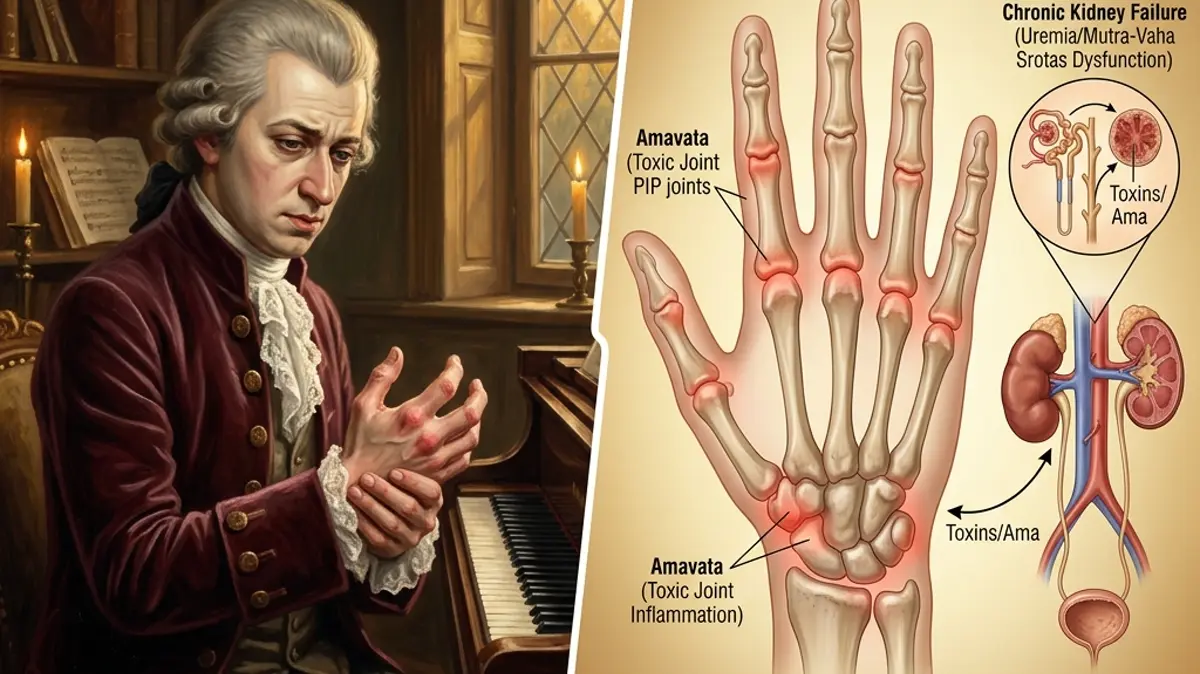
Featured image attribution: Left panel displays a visual representation of composer Wolfgang Amadeus Mozart at his piano showing severe hand and joint pain. Right panel shows a detailed clinical 3D anatomical illustration highlighting the hand bones under toxic joint inflammation (Amavata) and the structure of the urinary channels (Mutra-Vaha Srotas) and kidneys under renal failure. Modified by cropping and compositing.
Dr. Dhanushika Dilshani
Expert Ayurvedic Wellness Doctor. Specialized in modern holistic wellness, optimizing dermal resilience, cosmetic radiance, and systematic diagnosis driven by traditional and evidence-based medical logic.
Medical Disclaimer
The information provided by AyurPhysio is for general educational and informational purposes only. It is not intended as a substitute for professional medical advice, diagnosis, or treatment. Always seek the advice of your physician or other qualified health providers with any questions you may have regarding a medical condition. Never disregard professional medical advice or delay in seeking it because of something you have read on this website.
Trending Guides
Luka Modrić's Daily Routine: Low-Impact Resistance Training and Midfield Longevity
4 min readHarry Kane's Daily Routine: Hamstring Preservation and Anti-Inflammatory Nutrition
4 min readKarim Benzema's Daily Routine: Cupping Therapy (Hijama) and HIIT Conditioning
4 min readNeymar Jr.'s Daily Routine: Joint Stabilization and Hyperbaric Oxygen Therapy
4 min readMohamed Salah's Daily Routine: Early Morning Conditioning and Hyperbaric Recovery
4 min readWeekly Wellness
Don't miss the next guide
Get holistic health tips and new guides delivered to your inbox.
Related Healing Guides
View All Guides →
Luka Modrić's Daily Routine: Low-Impact Resistance Training and Midfield Longevity

Harry Kane's Daily Routine: Hamstring Preservation and Anti-Inflammatory Nutrition