"When rebuilding a shattered body, gravity is initially your absolute worst enemy. It creates crushing axial force before a callus can stabilize a fracture. The clinical masterstroke in multi-trauma rehabilitation is finding a way to simulate zero-gravity, allowing the brain to relearn how to walk long before the bones can physically support the weight."
When Marvel superstar Jeremy Renner was crushed under a 14,300-pound PistenBully snowplow on New Year’s Day 2023, the surviving medical reality was nothing short of miraculous. The incident left Renner with over 30 broken bones, a collapsed lung, a pierced liver, and severe blunt chest trauma.
While his immediate surgical survival captured global headlines, his journey over the subsequent 18 months presented one of the most fascinating and rigorous cases of clinical multi-trauma orthopedic rehabilitation in modern history. For a patient whose skeleton was effectively crushed, returning to normal, unassisted bipedal gait demands a masterful execution of physiological loading and neurological motor remapping.
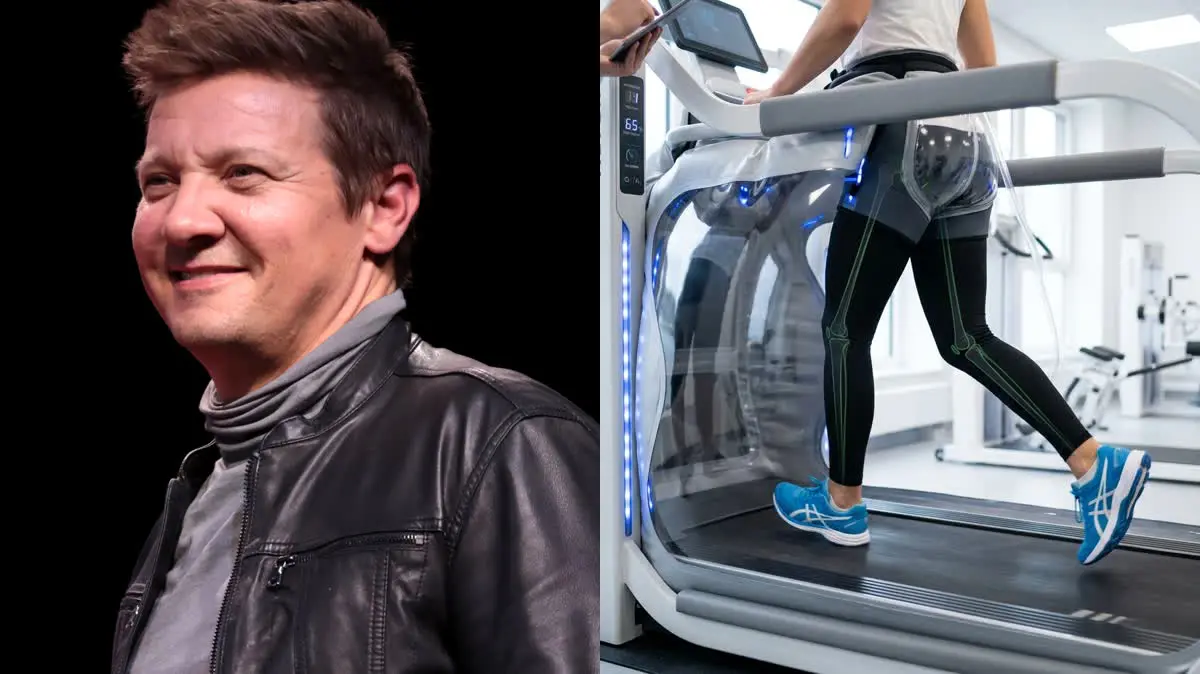
As a physical therapist, deconstructing the biomechanics of Renner’s recovery yields an essential roadmap for any patient recovering from high-velocity trauma or compound joint reconstructions. The pivotal tool that accelerated his miraculous transition from a wheelchair to walking the red carpet was a high-tech clinical innovation: the AlterG Anti-Gravity Treadmill.
The Pathophysiology of a Crushed Skeleton
To understand the complexity of Renner's rehab, one must analyze the staggering distribution of his skeletal injuries. His 30+ fractures included:
-
1Blunt Chest Trauma (Flail Chest) Broken ribs in multiple places cause the chest wall to lose its structural integrity. This creates a condition known as flail chest, where a segment of the ribcage moves paradoxically to the rest of the chest during breathing, causing extreme mechanical inefficiency and pain.
-
2Pelvic Fractures (Multiple Ring Disruptions) The pelvis is the central hub for forces transitioning between the spine and lower limbs. Fracturing this ring requires prolonged, strict non-weight-bearing protocols to prevent structural shifting of the sacroiliac and pubic joints.
-
3Lower Extremity Comminutions Multiple shattered bones in the tibias, ankles, and clavicles demanded titanium plates, screws, and intramedullary rods to restore basic anatomic alignment.
In standard single-fracture cases, the adjacent healthy joints can be utilized for compensatory support. However, in multi-trauma profiles, the clinician faces a difficult paradox: the patient cannot use their arms to push up from a chair because the clavicles and shoulders are broken, and they cannot bear weight on one leg to offload the other because both limbs and the pelvis are compromised.
Historically, patients with 30+ fractures were immobilized in traction beds for months. Today, we know this is catastrophic. Just two weeks of strict bed rest can lead to a 15-20% decline in quadriceps muscle mass and profound bone demineralization (osteopenia).
Furthermore, the central nervous system rapidly "forgets" how to coordinate walking, leading to a complete breakdown in proprioception—the body's subconscious awareness of joint positioning. The clinical imperative is to begin moving the patient as quickly as medically safe, even if the bones cannot yet support 100% of gravity's pull.
The Technology: Rewriting Gravity with the AlterG
How does a clinician begin gait training for a man whose legs and pelvis cannot safely handle his 170-pound body weight? This is where differential air pressure (DAP) technology, originally developed by NASA and commercialized in the AlterG Anti-Gravity Treadmill, changes the clinical trajectory.
The patient steps into a specialized, airtight neoprene skirt zipped into a pressurized chamber enclosing the lower body. As the air pressure in the chamber increases, it creates a gentle, uniform lifting force against the user’s lower extremities.
This technology permits the therapist to reduce the patient's effective body weight by up to 80%, in precise 1% increments. For Renner, this allowed him to begin walking at just 20% of his total body weight, effectively simulating the gravitational environment of the Moon.
-
✓Pain-Free Range of Motion By removing 70-80% of joint reaction forces, patients can bend their knees, hips, and ankles through their full physiological range without exceeding their individual pain thresholds.
-
✓Controlled Osteoblastic Stimulation According to Wolff’s Law, bones grow and remodel in response to the forces applied to them. Small, painless loads (e.g., 30% body weight) stimulate bone-building cells called osteoblasts, accelerating the fusion of comminuted fractures without risking hardware failure.
-
✓Neuromuscular Re-education The brain receives sensory feedback from the feet striking the floor. Simulating a normal heel-to-toe gait pattern in the AlterG prevents the development of pathological "limping" compensation patterns that would otherwise devastate the lumbar spine.
Progressive Loading: The Long Road to Impact
Rehabilitation for catastrophic trauma is a meticulous numbers game. In physical therapy, we follow a highly structured Progressive Mechanical Loading Protocol:
Phase 1: Passive & Active Assistive ROM (Weeks 1–8)
Initially, Renner engaged in gentle passive stretching and isometric contractions in bed. The goal here was basic fluid movement to prevent deep vein thrombosis (DVT) and reduce inflammatory swelling around the metal implants.
Phase 2: Micro-Loading & Anti-Gravity (Weeks 9–24)
Once x-rays confirmed early trabecular bridging (the initial stage of bone healing), Renner transitioned to the AlterG. Starting at 20% weight, the load was incrementally increased by 5% each week. If pain levels exceeded a 3/10, the weight was temporarily dialed back to maintain a strict pain-free zone.
Phase 3: Full Gravity & Eccentric Strengthening (Months 6–12)
Upon reaching 100% body weight walking in the AlterG without compensatory limping, Renner could safely graduate to open-air walking. The focus shifted to eccentric load absorption—relearning how to control the body while stepping down, squatting, and absorbing shock through the titanium-reinforced tibias.
Reclaim Your Own Locomotion
Jeremy Renner's remarkable recovery was not magic; it was the result of unrelenting mental fortitude paired with advanced mechanical engineering. His journey serves as the ultimate clinical proof that even the most severely compromised skeletons possess a profound, built-in capacity to remodel and heal when guided by correct physical therapy principles.
Whether you are recovering from a routine knee arthroscopy or a complex multiple-fracture motor accident, the underlying biomechanical truth remains identical: do not rush the gravity curve, respect the healing timeline of your bones, and seek out advanced clinical loading tools that allow you to move safely and pain-free.
Featured image attribution: "Jeremy Renner" by Gage Skidmore, licensed under CC BY-SA 2.0. Modified by side-by-side compositing with a 1:1 clinical illustration of AlterG anti-gravity physical rehabilitation.
Dr. Dhanushika Dilshani
Expert Ayurvedic Wellness Doctor. Specialized in modern holistic wellness, optimizing dermal resilience, cosmetic radiance, and systematic diagnosis driven by traditional and evidence-based medical logic.
Medical Disclaimer
The information provided by AyurPhysio is for general educational and informational purposes only. It is not intended as a substitute for professional medical advice, diagnosis, or treatment. Always seek the advice of your physician or other qualified health providers with any questions you may have regarding a medical condition. Never disregard professional medical advice or delay in seeking it because of something you have read on this website.
Trending Guides
Luka Modrić's Daily Routine: Low-Impact Resistance Training and Midfield Longevity
4 min readHarry Kane's Daily Routine: Hamstring Preservation and Anti-Inflammatory Nutrition
4 min readKarim Benzema's Daily Routine: Cupping Therapy (Hijama) and HIIT Conditioning
4 min readNeymar Jr.'s Daily Routine: Joint Stabilization and Hyperbaric Oxygen Therapy
4 min readMohamed Salah's Daily Routine: Early Morning Conditioning and Hyperbaric Recovery
4 min readWeekly Wellness
Don't miss the next guide
Get holistic health tips and new guides delivered to your inbox.
Related Healing Guides
View All Guides →
Luka Modrić's Daily Routine: Low-Impact Resistance Training and Midfield Longevity
Harry Kane's Daily Routine: Hamstring Preservation and Anti-Inflammatory Nutrition